Showing posts with label birdwatching. Show all posts

Sunday, 16 November 2014

Sarchu to Nimmu.... via Tso Kar


Sarchu to Nimmu.... via Tso Kar


20 Jul 2014. Early morning in Sarchu is even colder. I have had a bit of a cold and uncomfortable night. Uncomfortable, not due to any uneasiness or discomfort due to altitude but more owing to the freezing conditions.


The idea today is to start at the crack of dawn and take in Tso Kar before heading out to Leh. It is just a 30 min detour one way and that is very doable if we pace ourselves well. Our campsite is at Nimmu, further out of Leh but that is fine. Nimmu is just a little over 30 kms ahead of Leh. The road conditions in Ladakh are expected to be really good and the passage that much faster.

We leave Sarchu at 0530 hrs. It is the crack of dawn.... the place is overcast and there is a bit of a drizzle. The wind is howling, it is snowing in the higher elevations of the surrounding mountains and I am chilled to the bone!


Right after we set out, we cross a little bridge which I am told is the boundary between Ladakh and Himachal. So now officially, we enter Ladakh! A little bit further we come across this signboard... the BRO has already been spreading the AIDS awareness message...! 


Looks like the BRO has already been spreading the message...

Driving along with the Tsarap Chu on our left, we reach the Gata Loops... starting at about 4200 mtrs altitude. This is a series of 21 hair pin bends before we hit the Nakila at 4739 mtrs. All along, the peaks seem to have a sprinkling of fresh snow on them... just as if they were some giant muffins with a drizzle of icing sugar on top! Very beautiful! 

Gata Loops

There is a fair amount of traffic on this route... even though it is so demanding a journey. The day is getting brighter and the scenery more compelling. All of a sudden I spot a dog sized something on the corner ahead. Its gait immediately gives its identity away. It is a Himalayan Snowcock. Lo and behold! There are two more right behind it and our Scorpio comes to a screeching halt. The moment we stop (with squealing tyres) and rush to get to our cameras, they scramble up the mountainside giving us precious little time to get in a few clicks. It is then that I realise that there is a fourth one too! Am I happy!! A brilliant start to the day indeed! 

Himalayan Snowcock

Lachulungla at over 5000 mtrs is cold and windy and we move ahead to Pang. It is very different from what I have imagined it to be. I have expected a couple of dhabas but this is like walking on Main Street.... at about 4700 mtrs! There are at least 7-8 dhabas each, on either side of the road catering to the hungry, sleepy, out-of-fuel or just a tired traveller. Imagine, a collection of 15 odd dhabas looks like ‘Main Street’ after driving in these remote areas!!! Gives an idea of how sparse and patchy the habitation is in these regions.

A quintessential breakfast of maggi and tea later, we are off. The road loops up high over Pang giving a panoramic view of the settlement there from above as well as the valley of the Lachung River with those typically distinct geological formations in the valley, the result of high velocity winds in the area.  

Lachulungla.. with a sprinkling of fresh snow


The dorm-beds at the dhabas at Pang

The dhabas at Pang also offering  tented dorm-type accommodation.


Pang, from the road above

A close-up of Pang


Goelogical formations reminiscent of medeival castles!

Lachung river valley

Moving ahead we come to the famed Morey Plains. A vast area of flat land surrounded by mountains... with Kiang (Wild Asses) grazing lazily in small probably family groups and loads of little birds foraging around the roadsides as well as the small clumps of grasses around. These plains are high altitude semi-desert plains at just under 4800 mtrs and part of the Tibetan plateau kind of habitat. The flora and fauna here also exemplifies this fact. Tibetan Larks, Horned Larks, Twite, Great Rosefinch, Tibetan Snowfinch...

Driving through the Morey plains

Great Rosefinch

Tibetan Lark

Twite

Horned Lark chicks

Kiang

Tibetan Lark

The fabulous road through the Morey plains ends at a place just short of Debring. A minor road branches off to the right taking us towards Tso Kar. Though a rough and narrow road, it is easy going on it. A half hours worth of drive brings us within sight of the lake.

Tso Kar is a salt water lake and salt deposits are visible along the lake margins. This is one of the numerous lakes dotting the south east part of Ladakh. It is a breeding ground for the Common Redshank, Brahmany Shelduck, the Bar-headed Geese and the most sought after avifauna here – the Black necked Crane. The latter is a critically endangered species of which there are estimated to be just 200 to 300 left in the world. 

We are lucky to spot a Black necked Crane right upon entering the lake area and even before the little settlement of Thukje. There are marshes around the lake which are the favoured habitat of these handsome birds. For me, this entire trip has been worth it just to see these beautiful creatures...

The sandy soil at the edge of the lake is very soft and the vehicles are sinking appreciably driving on it. There are sand banks a little way inside the lake where we spot some Common Redshanks and Lesser Sand Plovers in breeding plumage. To the right, are a flock of Brahmany Shelducks. All around in the small scrubby patches of grasses around are Tibetan Larks, Tibetan Snowfinches, Twites and a lone Desert Wheatear. Near the settlement there is a stony retaining wall on which we spot the Little Owl. Very cute! 

Tso Kar

White winged Redstart Juvenile

Little Owl

Common Redshank in breeding plumage

Black necked Crane

There is very little visible in the way of accommodation here. There are a couple of tented camps near Pongunagu right at the point one first sees the lake. Since it is a day trip for us, we do not check out any stay options. After spending a half hour there, we head back towards Debring and the main highway.

The roads are very good most of the way today except for the detour to the lake though one can’t really call it bad. The area around Debring is dotted with the tents of the nomads (the Changpas) spaced well apart though loosely congregated within say shouting distance of each other with the sheared wool from their livestock (sheep) lying outside all along in this region.  Either they are doing well for themselves or it is the monetary help extended from the government that enables the presence of an SUV outside each tent we see! 


A lone tent of one of the Changpas

The road slowly ascends in wide loops. Right at the very distant top, we cross the famous Thanglangla, the second highest pass in the world at over 5300 mtrs. The views from here are superlative...

Thanglangla

View from almost the top of Tanglangla

As we drive towards Upshi and Leh, we pass Rumtse with tiny fields all bright yellow and vibrant green alongside the pristine blue of the river. There are chortens on the wayside and the landscape changes colour at regular intervals. Right about here there is a startling change as the mountains aroud take on a vinaceous hue! 

Vibrant yellow fields along the way at Rumtse

Changing colours of the landscape

At Karu we turn towards the Hemis Gompa for the benefit of our fellow passengers. We have done this trip (to Leh) before and seen the monastery. We spend the time birdwatching around the Gompa. A treat it is! 


Tibetan Snowfinch feeding its young

Mountain Chiffchaff

Chukar

Black billed Magpie

It is getting dark and we move out towards Leh. I look forward to seeing the Stakna Gompa even from a distance since I totally love the setting it is at. Much photographed, it looks mysterious, enticing, austere yet vibrant all at the same time! 

The much photographed Stakna Gompa

This is definitely one of the most scenic routes I have ever driven on... all the way from Shimla, through Kinnaur, Spiti, Lahaul and now Ladakh! I feel blessed to witness such beauty firsthand!

We drive through the outskirts of Leh and go towards Nimmu on the other side. Enroute we stop at the Gurudwara Patthar Sahib and the Magnetic Hill, regroup with one of our other vehicles and then proceed to our campsite. It is after dark by the time we reach our camp. The gush of the Indus is heard in our tents since we are right at the river’s edge. A campfire set up at the riverside is beckoning. A sumptuous dinner later we hit the sack!

The journey continuous...    

Monday, 30 December 2013

The High Fliers......

Birding at Veer Dam.... 

These Bar-headed Geese migrate all the way over the Himalayas from Siberia to their wintering grounds in the Indian subcontinent...

A pictorial essay.


Brahmany Shelduck in the foreground with the Geese in the background.


The Kentish Plover

Ashy crowned Sparrow Lark

A trio of Green Bee eaters


Spot billed Ducks


The most interesting of them all.... a Marsh Harrier (f) quietly biding it's time to prey on some of the small plovers and wagtails/larks.

Saturday, 14 September 2013

Tour of Uttarakhand - Kakdagaad Haridwar

Part 1 Morena is here
Part 2 Lansdowne is here
Part 3 Enroute Joshimath is here
Part 4 Badrinath is here
Part 5 Auli - Tapovan - Kanchula is here
Part 6 Chopta Tunganath is here
Part 7 Devariyatal (Deoriatal) is here.
Part 8 Kakdagaad Haridwar is here.

Despite the fact that no views of snow clad peaks or reflections were visible in the beautiful emerald waters of the Tal, Devariyatal has been an uplifting experience. We tidy up the baggage in the boot of the car and start out towards Ukhimath in the rising heat of the day. We had had a flat yesterday at Kanchula Kharak and our priority at Ukhimath today is to get it fixed. The mountainous roads with their numerous bumpy landslide areas do not generate any confidence without at least a spare tyre in good condition. 

Mission duly accomplished at the first auto repair guy we see, the bypass is taken to head out towards Kakdagaad without entering Ukhimath. Kakdagaad is a very small settlement just 4-5 kms south of Kund on the Rudraprayag road. A well known birding guide Mr Yashpal Singh Negi has a little place there called the ‘Mandakini Magpie Birding Camp’. It is right on the banks of the gushing Mandakini. This is where we are headed. At the end of our long driving trip, we intend to dedicate the last full day to birding. 

The Camp is reached in quick time... we do not realise it is so very close to Kund. We have not warned them of our lunch requirement so when we enquire about the availability; we are offered Khichadi as the quickest option which we accept with alacrity. This place seems to me to be just a collection of 5 – 6 little dhabas and this camp. A few yards down the road are two small houses. Some of these dhabas are run by the locals, some by Nepali migrants (or maybe they just come in the season time) and one even by a Bengali. There are a number of organised tour buses passing by here during the pilgrimage season and these joints cater to the specific needs of these various groups.

Mandakini flowing alongside our camp

After lunch and a short nap, we are ready to explore the surroundings. Another (Bengali) family is put up in the room just a half level up. The lady is evidently setting out for some birdwatching with camera and guidebook in hand. We tag along quite happily. A hundred metres away is a bridge across the stream which joins the Mandakini here. Right under the bridge is where we are headed. The path which leads us down to the water’s edge is very precarious. All rubble and loose mud which on the steep incline makes us slip and slide all the while hanging onto the (expensive) equipment we are carrying. There is birdsong all around.

Making our way over the small and large stones on the edge of the water, we come to a little space where the water has been channelled away from the main stream into a little pool which serves to attract the small birds for a dip. Taking up positions behind a large boulder, we start our vigil at the ‘swimming pool’ as Negi calls it. We do not have long to wait. Whiskered Yuhinas, White eyes, Western crowned Warblers, Blue-fronted Flycatcher, Black chinned Babblers, Crimson sunbird, Black Bulbuls and a plethora of birds are vying for our attention. An Emerald dove comes along for a dip but shies away on spotting us. There are Black Bulbuls with their juveniles and a juvenile Brown Dipper bobbing away in the water. Plumbeous Water Redstarts are zipping across the water; the Black lored Tits are plentiful; the Verditer is as common as the crows in the plains; the Great and Blue faced Barbets put in an appearance; the Asian Paradise Flycatcher adult male with his glorious streamers is flitting around. I am in HEAVEN! So many of these are first sightings for us and we are absolutely astounded with the variety and sheer density of birdlife here.

Black lored Tit

Blue faced Barbet

Blue fronted Flycatcher (f)

Blue fronted Flycatcher (m)

Great Barbet

Oriental White eye

Plumbeous water Redstart

Russet Sparrow

Whiskered Yuhina
As darkness falls and taking pictures is no longer possible we head back. On the banks is a little stone shaped somewhat like a Shivling. The local folks have added some Trishuls and come down to worship at it. We see a brother-sister pair at the little shrine praying. Their sincerity is visible on their animated faces. We reach them just as they are finishing their evening prayers. They are happy to pose for us.

Evening prayers at the Shivling....

We download the huge amount of data from the cameras, charge batteries, dinner and then bed. Bright and early in the morning, we are off on the guided tour with Negi. We walk towards the bridge where we went yesterday but instead of going down to the stream, we cross the bridge and walk a hundred or so yards up the road. A little path goes down to a foot bridge across the Mandakini which we walk across and birding starts in earnest now. Small Niltava, Spotted forktail, Slaty headed Parakeets, Grey Treepie, Babblers, Prinias... we keep climbing uphill and birding as we go along. It is a slow process but the rewards are stunning!

Grey Treepie


Slaty headed Parakeet

Small Niltava


Spotted Forktail

Verditer Flycatcher

Later we go down the road from the camp and see some more beauties. Wedge-tailed green Pigeons, Long tailed Minivets, we miss out on the White throated Laughingthrushes... The Chestnut bellied Nuthatch is very prompt when Negi plays the call from his cell. A very pretty bird this!

The afternoon is spent exploring the riverside. We see the Crested Kingfisher and the Black throated Sunbird. The Forktail decides to grant us close views and comes along to the water’s edge though on the other bank. The Dipper is happy to have us around. A very intensive day of birdwatching indeed!
Asian Paradise Flycatcher

Black throated Sunbird

Brown Dipper (juvenile)

Chestnut bellied Nuthatch

Chestnut tailed Starling

Long tailed Minivet

Wedge tailed Green Pigeon
A small video of a bathing beauty...


We set out for Haridwar early as we want to spend time and hopefully have breakfast at the GMVN hotel at Chandrapuri. On the banks of the Mandakini, it is said to be one of the best located GMVNs in Garhwal. We are not disappointed. The mellow gurgle of the waters here is so soothing, one can just sit on the banks and feel all the stress melt away...

Mandakini at Chandrapuri


There is not much choice for breakfast. Bread/butter/jam or puri-aloo ki subzi. The puri-aloo ki subzi is delicious. Usually not one of my favourite foods, this one is mouth watering! 

Past Rudraprayag, Devprayag and Rishikesh we reach Haridwar. We have some reserved rooms at an ashram at the Har ki Pauri. Parking in the huge car-parks outside, we walk into the congested lane leading us to the ashram. A quick check in, we deposit our overnight bags and step out the other side of the building onto the ghat. It is a revelation! The Ganga flows roughly 15 metres from the ashram. The ghat is well laid out. We turn right towards the temples and the bulk of the crowd.
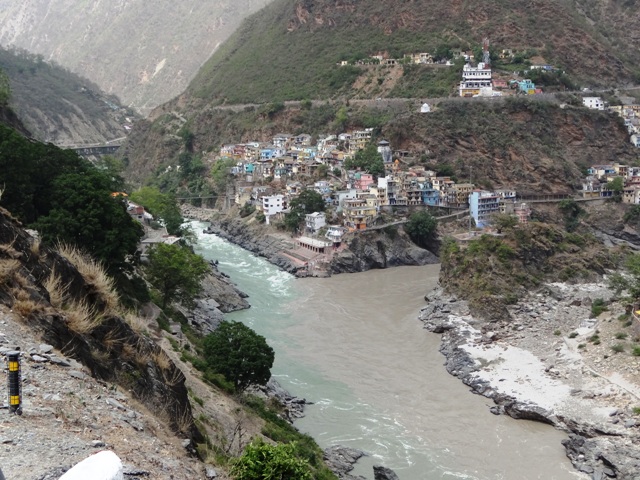
Sangam at Rudraprayag - Mandakini and Alaknanda


Sangam at Devprayag - Bhagirathi and Alaknanda

Sangam at Devprayag - Bhagirathi and Alaknanda

Hardly a few yards ahead, I am totally horrified and nauseated by what I see... Place stinking to high heavens, people are relieving themselves not 5-6 metres from the water under a foot bridge! I am ashamed to admit these are... INDIANS!

Up ahead and putting some distance between us and this stink hole, we settle ourselves on a bridge at a vantage point and watch the Ganga Aarti at dusk. The lamps set out in the water glow, bobbing along before vanishing quite abruptly in the fast moving current of the Ganges. A lot of piety around us... a lot of it genuine, some feigned and some totally farcical.

Har ki Pauri, Haridwar for the evening Ganga Aarti

Lamp from the Ganga Aarti

Har ki Pauri, Haridwar

It has been an experience not to be missed. For better or worse, it is one of the holiest places in India but our management of it is woefully inadequate (and I’m being very diplomatic!). Also, it’s time we as a people learn some basic civic sense and take pride in ourselves as well as our places of worship and our country as a whole. I live in hope... 

Dinner is at a small Rajasthani Dhaba with really yummy food. One thing we have experienced throughout the trip is that the food has been consistently good in the small places and not once have we had any tummy upsets. It just reinforces my belief that one must have what the locals have in the places that they patronise... one really can’t go wrong then.
Har ki Pauri, Haridwar at night
We leave very early in the morning to beat the traffic which we have come to dread. Even at 0430 hours, the roads are not empty. We reach Gwalior for the night without incident and then onwards to Bhopal. This road trip has been an amazing journey with much to see and much more to learn! Hope we will do something as enjoyable sooner than later. Till then, BYE...