Showing posts with label Goa. Show all posts

Friday, 10 March 2017

Heritage Heirlooms - The Caves at Lamgaon

INDEX

The Jain Temple at Kudne

The Caves at Lamgaon

There are two caves fairly close to each other near Lamgaon. The access to these used to be circuitous and long but in the recent past, it's a short walk from the village on a well marked though unpaved path. Just as one starts out towards the caves, and on what was the outskirts of the village then probably is a village deity guarding the perimeters of the village.  

Possibly village deities... right at the edge of the village.

The picturesque path leading to the caves...

These caves at Lamgaon have a Buddhist origin. The very name Lamgaon means the abode of the Lamas (Buddhist monks). The smaller of these has a nice courtyard with a Tulsi-vrindavan and a Nandi installed in it. The outer chamber has two columns on the outer facade and a smaller chamber inside, demarcated by two more columns  in between. The inner chamber is the sanctum with a Shiv-ling installed in at a later date. 


The smaller cave with the Shiv-ling in the inner chamber
  
The larger cave hollowed out of lateritic rock is quite big with a large assembly hall and a smaller inner chamber. This cave too has remnants of three columns and one column intact. The columns have a clear-cut stone beam-like structure connecting them on top but the floor is in very bad condition. 

The larger cave at Lamgaon

It is said that the smaller and the larger caves were connected by a tunnel the mouth of which is visible though I am not sure if anyone has tried access to it. 

A very large stone outside the entrance can be easily overlooked but on careful inspection seems to have the typical cornices and adornments associated with the Buddhist Chaitya Arches. It seems likely that at some time long back, this must have been the top portion of the cave entrance which has since fallen in due to the vagaries of nature...

The possible Chaitya Arch now fallen over

These lesser known sites are a joy to behold if one makes the effort to reach them. A must visit for all history and archaeology aficionados. If my narrative enthuses even a few to visit, it would all have been worthwhile....


Wednesday, 1 March 2017

Heritage Heirlooms - The Jain Temple at Kudne

INDEX

The Jain Temple at Kudne

The Caves at Lamgaon


The golden age in Goa's history is undoubtedly in the reign of the Kadamba Dynasty. They ruled Goa from the 11th to the 14th century AD and had very good trade ties with Gujarat. In this time, many gujarati traders came and settled here with their families bringing with them their religion, culture and traditions. The tolerant Hindu Kadamba Kings paved the way for the integration and propagation of the Jain communtiy in and around Ponda and Bicholim. 

It was during the rule of the Vijayanagar dynasty that grants were given to establish Jain bastis including their temples and shrines. Jain relics have been found in Bandoda, Ponda and in Kudne, Bicholim Taluka. This Jain temple is located near an area called the Gujir Vaado in Kudne. The name itself suggests the place was the Gujarati settlement area once upon a time.

It was in the year 1684 that the Mughal armies under Aurangzeb burnt down and plundered Bicholim leaving it in ruins.

Jain Temple at Kudne

The Jain Temple at Kudne was once a beautiful little temple dedicated to Adinatha and belongs to the medieval period. The monument is thoroughly neglected today though it must have stood elegant in this charming and quaint village of Kudne. Said to have been built through grants in the early Vijayanagar era, it is an important monument from the time of the period giving us an insight into the prevalent building practices then. 

It is a proud structure built in the typical North Indian Shikhara style. The lateritic blocks uncovered point to the existence of arches in the Mukha Mandapa of the temple. The Octagonal Shikhara over the Garbha Griha  is five tiered including the semi-spherical lower part with a small rectangular entrance to the sanctum.

The five tiered Shikhara

A broken stone head of a Tirthankara (Jain religious leader) with beautifully sculpted curls was also found near the garbhagriha. A stone torso of a Jain Tirthankara with a srivasta symbol was also unearthed. The sculptural structure of the idols indicates that the temple belongs to the Kadamba period. This is the only medieval temple of Goa which has a nagara (Indo-Aryan) architectural feature.


Likeness of the Idol of the Tirthankara
This temple also has a marked semblance with the Saptakoteshwar temple at Narve and the Chandranath at Paroda.


Sunday, 26 February 2017

Heritage Heirlooms - The Petroglyphs of Usgalimal

INDEX

The Buddhist caves at Rivona

The Petroglyphs of Usgalimal

The Jain Temple at Kudne

The Caves at Lamgaon


The sun, sand and surf attract tourists from around the world to Goa. And yet, this is not the only claim to fame this beautiful land has. As late as 1993 saw the accidental discovery of some ancient rock carvings at Usgalimal (also known as Pansalimal) in the Kushavati river bed in Sanguem Taluka of South Goa. After a bout of flooding, the silt from some part of the laterite river bed got washed off and exposed beautifully chiseled figures. Seeing this, the locals scrambled to call in the archaeologists who have since extensively studied and analysed them.  

It is believed that these carvings date back to the 8th century BC or the upper Palaeolithic and Mesolithic period, perhaps more commonly thought of as “the Stone Age”and were created by the people of the 'Kush' tribe inhabiting this valley. This makes them a whopping 10,000 years old!! 

The carvings depict a wide range of subjects notably the bull, deer, antelope, peacock, dancing figure, mother and child, the mother goddess and the enigmatic 'triskelions'. These 'triskelions' are a concentric circle pattern more associated with the Celtic and European peoples and believed by some archaeologists to have been used to measure time. Elsewhere it's also called the circle of life.

Peacock

Dancing figure

The carvings are known as ‘Petroglyphs’, because they were created by chipping away the outer surface of the rock using a tool of some sort. They predate the rock paintings that have been previously discovered in other parts of India and are very different from them.

Mother Goddess

Animal figure

Hunting the Bison

Another Bull Motif

Animal fights
As with most prehistoric paintings as well as rock carvings, the predominant focus is on the animal figures as also some dancing figures and infants which suggests fertility rituals. The circle of life could point to some form of religious cosmology too.

The circle of life or the famous 'Labyrinth'

A trapping cage for game

The Kushavati River bed... site of the ancient Petroglyphs at Usgalimal

There is an urgent need for conservation of this unique and beautiful site. It's a silent testimony to the human urge for artistic expression from time immemorial. A little care will go a long way in preserving this heritage for future generations to get a peek into our prehistoric past!!

Saturday, 25 February 2017

Heritage Heirlooms - The Buddhist Caves at Rivona

As part of bringing the rich cultural heritage of Goa in the limelight and showing the average tourist and local alike that there are other, more beautiful facets of Goa they have not yet discovered, I bring to you the first in the series of .. - Heritage Heirlooms -

The Buddhist Caves at Rivona

Cave 1 

Located near the Kushavati river, in the village of Rivona (the name Rivona might have been derived from ‘Rishivana’ meaning the forest of sages, or in the present case, of monks). The site is called devachi zaga ( meaning the abode of God). This cave is oriented towards the east. It has a pedestal measuring 4.8 m X 3.2 m which fits the idol of Buddha and is called’ Sonyachi peti’ (Golden box). The idol of Buddha discovered at Rivona is seated in Vajrasana position with Bhumisparsha-Mudra (right hand touching the earth with the left hand kept on the lap.) A huge lotus pedestal for seating the idol was also found at the site.

The large Cave No. 1 at Rivona (Pic courtesy Preethy Nair)

Cave 2

This Cave is at two levels and has two entrances, one at the upper level and the other at the level below. The steps going down from the upper level lead to the chamber which has a skylight and a stream of fresh water. It also connects to the lower entrance. The skylight chamber leads inside to another chamber which has a stepped platform built of laterite and which has a vaulted ceiling. This cave has seen some intervention by later humans since there are laterite bricks neatly laid at the upper entrance and a tank made behind at the lower level. 

Cave no 2 Upper entrance (Pic courtesy Vandana Balakrishnan)

Lower entrance to the Cave 2

The tank behind the lower entrance

The Skylight in the chamber of Cave 2


Source: Cave Architecture in Goa-A project report submitted to the Goa University in partial fulfillment of the requirements for the Degree of Bachelor of Architecture by Varun Desai


Saturday, 20 September 2014

Journey to the top of the world


Goa - Delhi.... the journey begins in the plains


Chhitkul... the emerald green valley!

Destination Pooh...

Spiti.... journey through ‘The middle land’


Road to Chandratal


Chandratal to Sarchu... a picturesque drive through Lahaul


Sarchu to Nimmu.... via Tso Kar


Having done our fair share of road trips as a family, we are now intrigued by the possibility of doing a ‘Rally’ as a group. After much planning and preparation the itinerary is finalised and the nitty gritties sorted out. We are going to be a group of 17 in 3 Scorpios and one Bolero starting from Goa and going all the way to Leh via the Spiti Valley. Of this, 12 will start from Goa with 3 joining in Delhi and 2 in Chandigarh. The second team would take over in Leh and drive back via Kargil, Srinagar, Amritsar and Delhi to Goa. Apart from this being an adventure trip, we are also going out with an AIDS awareness message.


10 Jul 2014. The earth seems enveloped in a grey blanket of fog at 0530 hrs as we set out and this follows us all the way through to Amboli where the clouds almost kiss the road and the valleys play hide ‘n seek with the awestruck traveller. Waterfalls small and big, entice the passersby to tarry a while and take in the splendours of the monsoon in the Western Ghats. We bow to these temptations and take the much awaited breakfast break satiating more than just the appetite for food! 


Valley at Amboli obscured by clouds


A tunnel on the Mumbai Pune Expressway 


Mumbai Pune Expressway


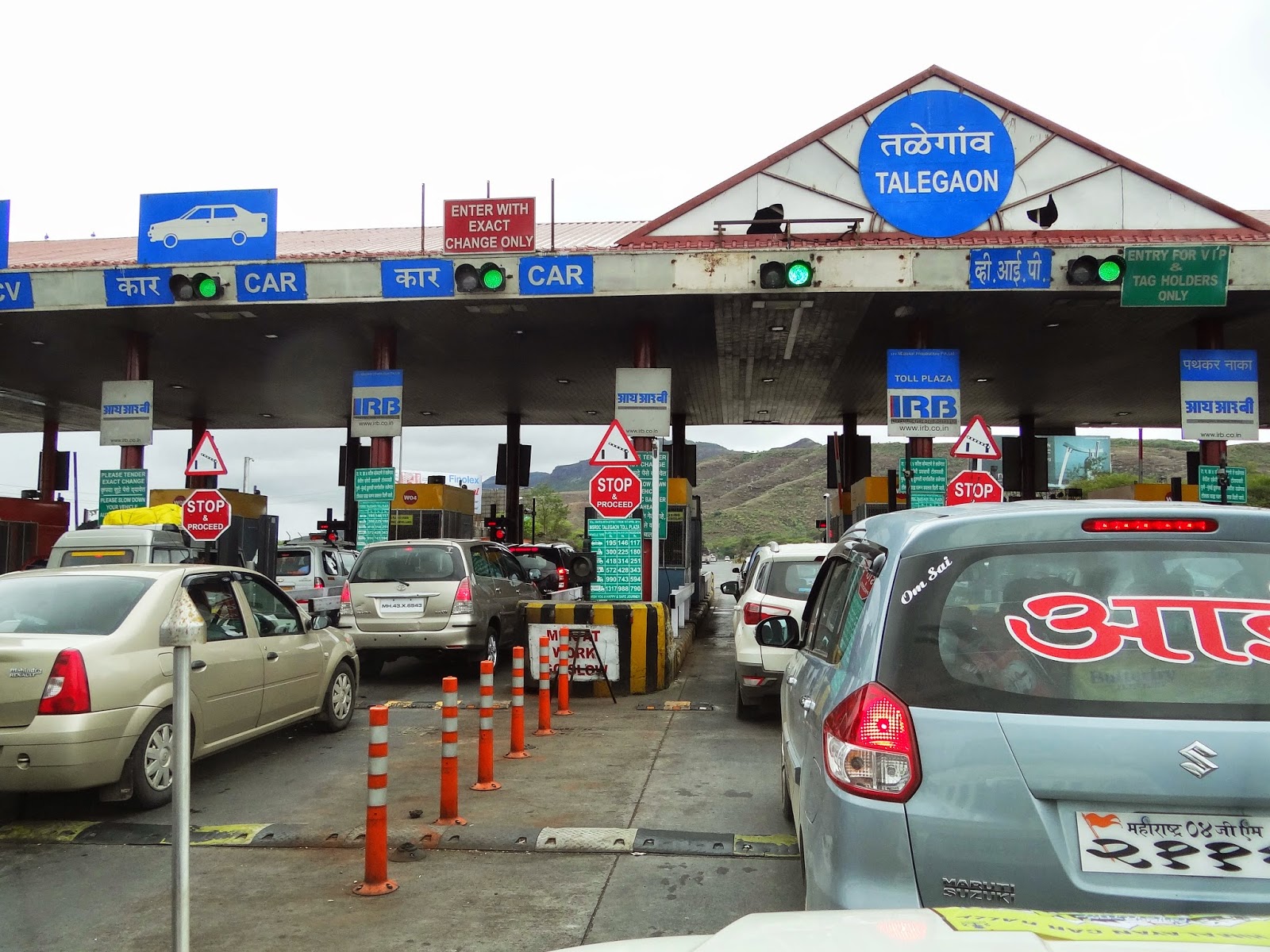
The rest of the journey till Mumbai is just another highway with nothing to recommend it but a means to an end.  After the mandatory getting-lost-and-going-round-in-circles-before-finding-the-destination that we seem to do in most new cities, we reach our destination after 2 solid hours of wandering the drowning streets of Ghatkopar in a downpour worthy of .... Mumbai!  The thing to note is that more time was spent in negotiating the traffic (read: stuck in traffic) than driving! We finally reach and after a round of socialising with some local friends, we retire.

11 Jul 2014. Another 0530 hrs start ensures that we exit Mumbai without a sweat. 


Exiting Mumbai


Badoda Highway


The Ahmedabad highway is a dream.... the only fly in the ointment is the enormous truck traffic making driving on it akin to a formula 1 experience! The incessant and torrential rains don’t help either! After Vapi, the showers recede and a little bit later, disappear altogether. Lunch at Badoda after which we decide to heed some advice from frequent commuters on this route to Udaipur and take the inner route to Udaipur via Modasa bypassing Ahmedabad.

For this we exit the highway at Nadiad and take the state highway. Within 10 kms of the turnoff we have our first breakdown of the trip. Mahindra has sponsored the vehicles for this rally and promised us technical support through this tour. We call for help and are pleasantly surprised to have the recovery vehicle come by in an hour. The service personnel check out the problem and decide that the vehicle needs to go to Anand (back about 40 kms) since it is a larger service centre. Decision is taken to leave the sick vehicle with 3 members and the others to shuffle and move ahead to the designated halt at Udaipur.

We pass a small village fair and then a small pond a few hundred metres ahead has good bird life which we gleefully document....


A small village Mela


Cattle Egrets in breeding plumage


Pheasant tailed Jacana


Pond Heron


Meanwhile, a lot of time has been wasted and it is almost dark.  Udaipur seems very far off... we finally make it by 2345 hrs. In hindsight, the progress on the national highway may have been faster given that we drove after dark! A very long tiring day indeed!

It is said that a thing of beauty is a joy forever. How true this is is brought out by the fact that in spite of the exhausting journey of the day, we still find the time (and energy) to marvel at the magnificent sight of the famed Pichola lake which is spread out below our Guest rooms. The reflections of the lights from the palaces in and around the lake make for a magical setting quite like sparkling jewels beckoning from afar! The picture says it all!


Reflections


Good night ... zzzz


Lake Pichola Udaipur


View from our room....
12 Jul 2014. We leave Udaipur at a more leisurely hour of 0700 hrs. A long drive without incident sees us at the outskirts of Jaipur at about 1330 hrs. Taking a detour to a goat farm on the other side of Jaipur sets us back by 2 whole hours!


Goat farm
The farm is owned and run by the father of one of the team members. A gastronomically satisfying break later, we are on our way to Delhi. The nightmare begins.... the miserable road conditions and the extremely unruly traffic crawling agonisingly forward is distressing! The quantum of traffic is adding to the woes. Coming from a relatively calm place like Goa where sanity prevails no matter the provocation this feels like alien country. I almost feel timid in comparison to the fellow drivers!

Checking into our hotel about 2300 hrs it takes us a while to freshen up, have dinner and then hit the sack. Thankfully, it is a late start tomorrow.

The entire journey from Goa till Delhi has been just driving, driving and then some more driving. The rains have kept us company till Vapi or thereabouts. After that it has been pretty much dry. In fact, Udaipur was just comfortable in the morning but the day has been very hot and it is scorching in Delhi!

The vehicle left behind has been repaired (a choked fuel filter and lines which needed replacement) and the team has brought it till Jaipur today. They will catch up with us tomorrow morning. There is a sense of quiet excitement in the team since the real rally starts tomorrow. This road trip can only loosely be called a rally since there are 4 vehicles participating and going as a team though without any competition. We hit the hills tomorrow. We are on the threshold of the most exciting part of the trip. The journey to the top of the world!

The journey continues.... 

Tuesday, 24 September 2013

Bonderam - The Flag Festival of Divar Island, Goa


With the objective of seeing more of Goa than the usual sun, sand and surf, we set out one Saturday afternoon to the quaint island of Divar in the Mandovi River. Divar Island, which hosts the colourful festival of Bonderam, is situated roughly 12 Kms north-east of Panjim, the state capital. It is reached by ferry from Old Goa as well as Ribandar.

A little background on this ‘one of its kind’ festival. The "Bonderam" festival is celebrated on the Island of Divar on the fourth Saturday of August every year. The word "Bonderam" originated from the involvement of flags. "Bandeira" is the Portuguese word for flag. It is stated that during the Portuguese rule in Goa there were frequent disputes between two sections of the Divar village, namely Sao Mathias and Piedade over property issues. These often led to violence and fights in the village. Subsequently, the Portuguese introduced a system of demarcation of boundaries with flags. The rival groups, however, knocked down the demarcation flags sometimes with stones. Till recently, in a parody of the past, this was commemorated with a "Fotash" fight (toy weapon of bamboo stem) and berries were used as missiles in a mock fight between rival groups to knock down an offending flag. However, today this practice has been stopped as it has resulted in eye injuries etc. although this bamboo ‘Fotash’ is still visible as part of the parade.

We are a little hesitant to wilfully put ourselves into a place which is bound to be very crowded but our determination to see this unique fiesta overrides all these concerns. And a fiesta it will be, for any event in Goa is inevitably colourful, joyous and an expansive festivity. We reach the ferry point at Old Goa and fall in the queue to board the next ferry. This is probably the first time in my acquaintance with Goa that there is such a long line waiting for the ferry. Not only that, there is a substantial police presence which is efficiently guiding the burgeoning traffic very smoothly without any traffic snarls or inconveniences to local commuters and tourists alike.

In the distance, we see a ferry coming in to dock... and what a pleasant surprise! Even the boat has been draped with multi-coloured flags! The short drive from the ferry point takes us to the fest site. Walking in from the parking area, we join the hordes all pouring into the streets trying to get vantage points to see the procession from. There are bamboo barricades along both sides of the road most of which are already packed with people all waiting for the parade and tableaux to start.


The Ferry
The festive spirit has already reached out to residents and sightseers alike creating a magical, sort of carnivally atmosphere where pageantry and celebration is the order of the day.


People crowding onto balconies and verandahs to catch a glimpse of the festival parade 
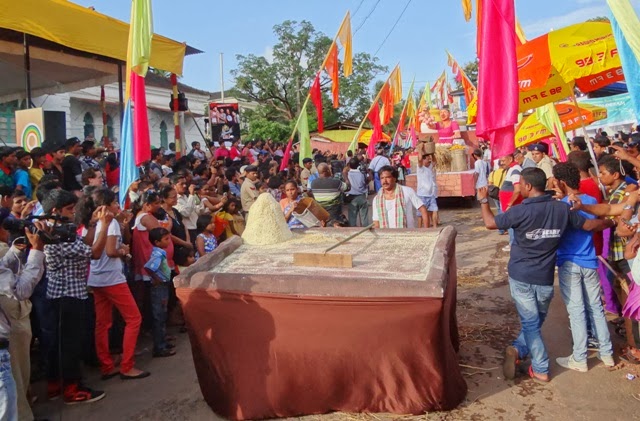
At long last, the flag parade starts accompanied by the brass band. The Bonderam festival is declared open! The first of the groups moves forward, little children dancing to a typical Goan-Portuguese number. They are followed by young (and the not so young!) adults performing to the same music. These troupes do their bit, move forward and do a little more of their jig before moving on followed by the floats. Divar has six wards and each ward in the island has its own float. This way, the parade moves forward with the cheering spectators falling over themselves to see and applaud the passing ensembles. Each section of the parade (six, one for each ward) has very distinct themes and music to go with it. I’ll let the pictures illustrate in greater detail.


The dancing starts!


The drummer in the lifesized brass band
From agriculture, fishing and rural markets to fitness and lifestyle, from nature and environment to the indigenous cuisine, the floats depict a very wide variety of ideas and force the onlooker to think and sometimes even introspect about the direction our anglicized, western-thinking-influenced lives are taking.


Add caption


Add caption


Add caption


Add caption


Add caption


Add caption


Add caption


Add caption


Add caption


Add caption


Add caption
Take for example the float titled ‘Revival of Old Traditional Games for Fit and Healthy Life’. Then, the games used to be physical and outdoors, and now they only exercise the digits! Not only the children, even the adults today go to gaming parlours or play at consoles home and elsewhere rather than get out and play a game in the field.


Revival of Old Traditional Games for Fit and Healthy Life


Float depicting the traditional games... Gilli Danda, Tennicoit, Pitthu


Marbles


Seven tiles or Pitthu


Tennicoit or ring
Addicted to gaming!


Modern marvels...


Addicted to their consoles...


Addicted!


A few speeches between the tableaux have the crowd waiting impatiently for the parade to recommence but the organisers being conversant with this have kept the speeches to a minimum and as the parade resumes, the assortment of intriguing characters and vivid scenes file past.
Nature theme float


Another Nature themed float


Nature theme...
Some random scenes from the Float Parade...


There are scenes from a regular Goan kitchen, preparing the famous Goan Sausages, distilling the local brew FENI or harvesting crop and feeding the cattle as farmyard scenes. All these are interspersed with the exuberant participants young and old alike taking to the streets dancing and singing and their gaiety is so infectious that it is a spirited and participative audience joining in the revelry regardless of caste, creed, nationality or language. It is true that happiness is contagious!


Ploughing the fields...Farmyard scene


Fisherfolk dance


FENI distillation


The procession draws to a close and it is almost dark. The lights are shining brightly in all the homes and the stalls set up for today. The DJ has started revving up the volumes.... It is either westernisation, change in sensibilities or economic crunch that has a hand in it since it is probably the first time that a band is not performing after the parade, just a DJ. All the same, the people are enjoying themselves and sadly, some (domestic) tourists are making a nuisance of themselves by their drunk and disorderly conduct. In fact, the few foreign tourists have actually bothered to dress in Indian clothing and are some of the best behaved here! No more are the ‘scantily clad’, ‘rude’ and ‘obnoxious’ labels reserved for the foreigners (though some may warrant it sometime, not today though!).


A festival banner


Crowds milling around after the parade


The DJ revving up the volume and the energy!
We make our way back to the parking lot and are happy that we attended this quaint and unusual festival for the enthusiasm and passion has been contagious and enlivened our lives and our spirits. Viva Bonderam!

A beautifully lit house at Dusk