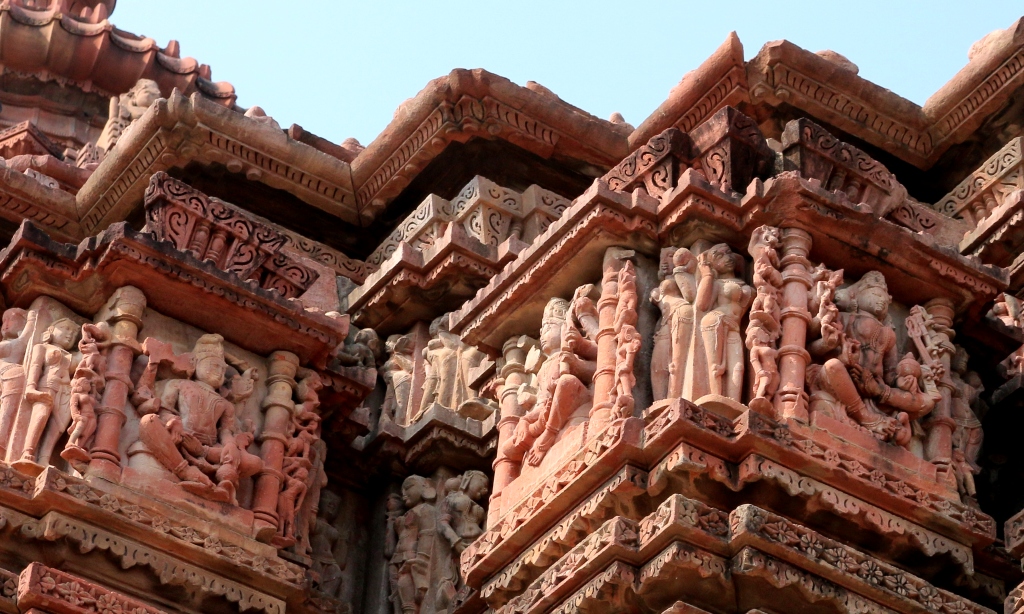
The Soul of Incredible India - The Sun Temple at Konark
The Soul of Incredible India series -
The Sun Temple at Konark
Kichakeswari Temple
Dhanobeni Temple
The Leaning Temple of Huma
The Sun Temple at Konark
In this new series, I'm going to pick and write posts on the culturally vibrant state of Odisha.
The Sun Temple at Konark is arguably the most famous tourist site in Odisha. It is the exquisite culmination of the Kalinga style of temple architecture. Dating back to the 13th century AD, this intricately embellished Temple Chariot of the Sun God was built by King Narsimhadeva of the Eastern Ganga dynasty.
There is a story from the 'Samba Purana' surrounding this place. It is said that Saam or Samba, the son of Lord Krishna was cursed with leprosy. He performed severe penance for 12 years invoking the Sun God at a Sun temple he built in Mitravana on the banks of the Chandrabhaga river here and was cured. Even today in Odisha, this day is celebrated as the Samba Dashami on the 10th day of the Shukla Paksha (waxing moon fortnight) of Pausa masa (10th month of the Hindu calendar roughly in January). On this day, mothers pray to the Sun God for the health of their children!

The very name Konark is an amalgamation of two words - 'Kona' meaning corner and 'Arka' is another name of the Sun God. The Sun god worshiped in Arka Kshetra is also called Konark. In 'Brahma Purana' the Sun God in Ark-kshetra has been described as Konaditya. So it is evident that the place where the Kona Aditya (or Kona-arka, the Sun god) was worshiped was also popularly called Konark.

It is not well documented and a matter of controversy what caused the destruction of this pinnacle of Kalinga art, natural erosion (causes) or a desecration by invading armies.
The Konark temple has the main sanctum called the Vimana housing the main deity which is said to have had a Shikhar well over 200 feet high which has since fallen in. The Jagamohan or the assembly hall which is the bulk of the ruins visible today. The third is the Nrityamandapa or the dancing hall. This temple did not have a separate Bhogmandapa like the Jagannath temple at Puri or the Lingaraj temple at Bhubaneswar. Dancing and offering were probably both done in the same space.
This temple has been built according to vastushastra. As one enters the Temple grounds, to the left and in the south-east is the temple kitchen now in ruins. On the right in the north-east direction, is the puja mandap and the well for water.
Directly in front is the Nrityamandapa with stairs leading up to it's high platform. The stairs are flanked by the fierce lion atop an elephant which has a man under it. This is supposed to symbolise that one must leave behind the arrogance of both intelligence and strength before entering the God's abode...

The roof has fallen in but the ornately carved platform and the pillars above are a treat to the eyes. Most of the sculptures here are of musicians and dancers.
Directly in front is the Nrityamandapa with stairs leading up to it's high platform. The stairs are flanked by the fierce lion atop an elephant which has a man under it. This is supposed to symbolise that one must leave behind the arrogance of both intelligence and strength before entering the God's abode...

The roof has fallen in but the ornately carved platform and the pillars above are a treat to the eyes. Most of the sculptures here are of musicians and dancers.
 |
| Musicians and dancing girls |
The Konark temple has been built in the likeness of a gigantic chariot of the Sun God pulled by 7 horses symbolising the 7 colours in sunlight as also the 7 days of the week. The chariot sits on 12 exquisitely carved pairs of wheels for the twelve months of the year. Each pair of wheels represents the 'Shukla paksha' (waxing moon fortnight of a month) and 'Krishna paksha' (the waning moon fortnight of the month). The wheels are also sundials which can be read to an accuracy of 3 minutes!

Each of the spokes of the wheels have some representation of the daily rituals or calendar events. One of the axles of the wheels has the Narasimha god carved on it.


The middle row of sculptures are of everyday scenes and fabulous imaginary beings like the Gajasardula or the lion on elephant..
 |
| Lion trampling elephant |
... or the Naravyala (Lion on a man)... or the elephant trampling a man...
 |
| Elephant trampling a man |
The Nagamithunas or the half man half snake beings which are said to live in the ocean depths hoarding great wealth...

Even the King is depicted in some panels on seated on elephants meeting important emissaries from afar carrying exotic gifts of jewels and animals (like the giraffe, in this panel)
 |
| Envoys carrying fabulous gifts for the King like the Giraffe here |
There are everyday scenes like that of a lady doing Shringar (make-up)...
 |
| Lady doing Shringar with her helpers carrying pouches and vanity bags |
Punishments for petty wrongs would be the chopping off of the hair as shown in this panel. The expression on the face of the culprit is visibly sad!
 |
| Chopping off of hair as punishment |
One of the Sage Vishwamitra and Menaka..

Another of a mother-in-law sharing her experience of life with the daughter-in-law...

A panel showing the devoted Shravan Kumar..

Another a playful scene of monkeys stealing butter from the cowherd's lady!

The rows of sculpture above this are mostly erotica... and teachings of medicine in some places.
The superstructure made of regular sandstone has entryways which are made out of chlorite and ornately carved. The foundation and inner core of the temple is made out of laterite. In the Vimana, there are three idols of the Sun God in Chlorite facing south, west and north depicting the rising, mid-day and setting sun. These have been re-installed after they were found fallen off the Vihara and so are not in order...
Even though this megalith is nowhere near it's best with very large parts of it fallen, it still projects glorious aesthetics and brilliant craftsmanship. The aura of it's past grandeur still lingers in it's intended scale, the beautiful proportions of it's different spaces and definitely in it's peerless carvings.
Even though this megalith is nowhere near it's best with very large parts of it fallen, it still projects glorious aesthetics and brilliant craftsmanship. The aura of it's past grandeur still lingers in it's intended scale, the beautiful proportions of it's different spaces and definitely in it's peerless carvings.
A tribute to the prodigious talent of the artisans of Kalinga, the Konark temple is a masterpiece indeed!