Showing posts with label Himalayan Griffon. Show all posts

Thursday, 5 September 2013


Tour of Uttarakhand – Devariyatal (Deoriatal) Part 7


Part 1 Morena is here
Part 2 Lansdowne is here
Part 3 Enroute Joshimath is here
Part 4 Badrinath is here
Part 5 Auli - Tapovan - Kanchula is here
Part 6 Chopta Tunganath is here
Part 7 Devariyatal (Deoriatal) is here.
Part 8 Kakdagaad Haridwar is here.

Bidding adieu to Kanchula for the last time in this trip, we wind our way to Chopta. The beauty of this region is unmatched. The pretty meadows, the tall, tall moss-laden trees, the low hanging clouds almost drifting into the houses, abundant rainfall making it a cold and wet biotope which in turn supports an amazing diversity of birdlife and other flora and fauna and is still fairly remote.

A leisurely breakfast later, we embark on the next segment of our trip... beyond Chopta, through Baniyakund and onwards to Saarigaon. Baniyakund is upon us almost immediately after leaving Chopta. It couldn’t be more than 4-5 Kms. Another overflowing pipe at Baniyakund beckons us... carwash time J!

Baniyakund
Taking in the sweeping vistas around, I notice what look like sheep or goat walking up the hillside. Their walk is a little funny and just as I am contemplating their identity... they ruffle their feathers and unfurl wings making me gawk! What I am looking at is a flock of anything between 15 and 20 Himalayan Griffons! Running down to investigate, we notice them flocking at a carcass set out just beyond the little summer hamlet of cattle and goat herders. Also along the way are many woodpeckers and wagtails, flycatchers and warblers.

Himalayan Griffons

Himalayan Griffons


Rufous bellied Woodpecker

Ultramarine Flycatcher

Grey Wagtail
A lazily winding route takes us to Saari through dense forests and the now familiar bright green terraced fields. Saari is at a much lower altitude than Chopta hence the route is descending throughout.

View from Saari turnoff


Saari is a charming little village nestled half-way up the mountainside after which the mountain becomes pretty much vertical further up. We reach the designated BSNL tower at the entrance to the village and duly call our guide with whom we have booked our tented stay at the Tal. I am impressed that without any reminder or any advance, this gentleman has everything ready for us whereas the others I had contacted had not only quoted much higher for our stay but asked for advance also. A simple but tasty lunch and short rest later, we are set to start the walk up.

The trail to Devariyatal goes straight up from Saari with a lot of short and sharp switch backs, climbing far more sharply than the Tunganath route. Also, the Tunganath trail is well paved but this one has large and very loose stones making footholds precarious. Within minutes of starting the climb, I realise how very out of shape I am!! Huffing and puffing almost from the word go; it is slow progress up this demanding hillside. The slimmest excuse is grabbed to take a break...

The path has beautiful flowering bushes and Buran trees all along. We see birds flocking to some bushes just ahead. Our guide offers us berries (called ‘Hissar’ locally) from these bushes which are very like raspberries but yellow in colour. Sweet with a hint of sour, these are delectable morsels. He is a charming storyteller. In the welcome break that is spent catching our breath and munching on these juicy bits, he tells us a little mythological tale associated with these berries.

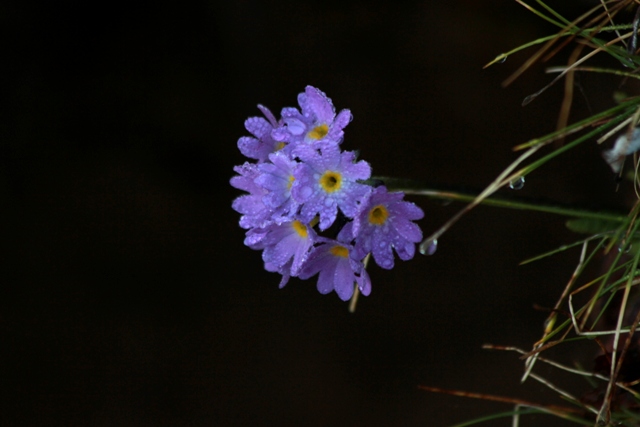
Burans (Rhododendron) flowers

Hissar berries
It is said that a very long time ago, there was one pujari for Kedarnath and Badrinath. He would do the puja at Kedarnath and then walk across to Badrinath and do the puja there. Only after the pujas would he eat anything. One day, God decided to test him and these berry-laden bushes grew on the route he regularly took. Seeing these berries, the pujari was tempted to eat some. The moment he did so, his fast broke and God became angry that the pandit broke his fast before the puja at Badrinath. As a result, Neelkanth (the snow-capped peak visible just behind the Narayan mountain and the Badrinath shrine) emerged blocking the path from Kedarnath to Badrinath. Nice tale and I can quite sympathize with the Pandit... these certainly are luscious berries!

Looking down upon Saari gaon from halfway up


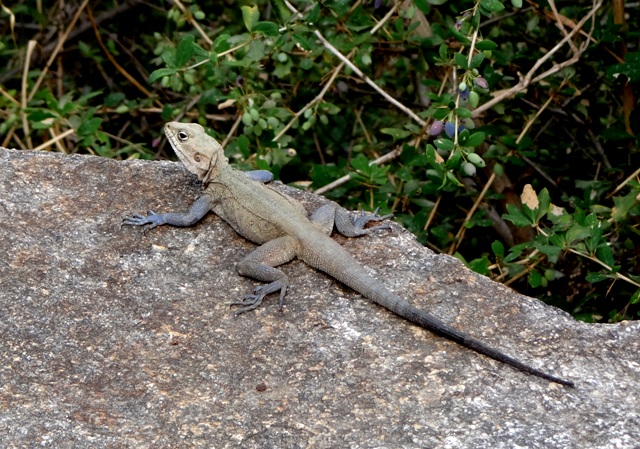
Blue limbed lizard
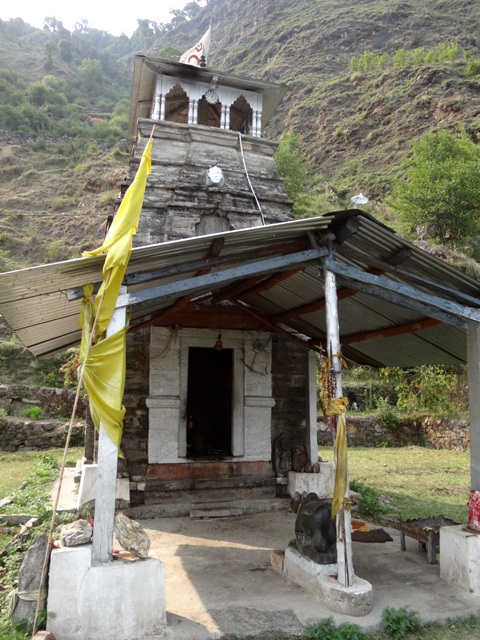
A little way up is the temple. It looks very old so I ask Negi when it was built. Apparently, the pujari is an ex-armyman (also a pandit then) who has built the temple some 20 years back but the aging of the structure is completely natural in this harsh climate giving it much older looks.


Temple

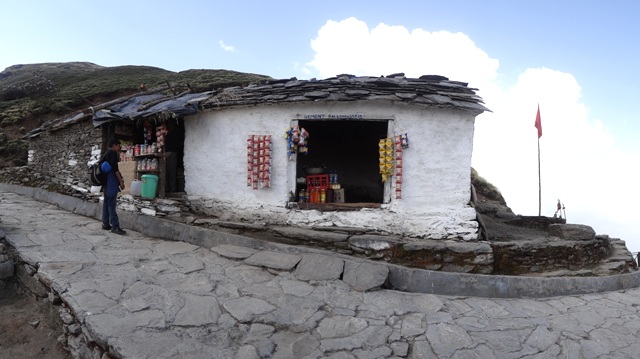
With the darshan over, we start the march up again. Two treks in a row have us all (at least the adults) quite tired. Many frequent breaks later, we finally reach the top only to realise that there is still a little more to be covered. Finally we reach the shop cum restaurant at the top from where the Tal is 100 metres away. It certainly takes our breath away... the lake is small and there is no view around whatsoever at this time of the year, however even now the place looks out of a fairytale. The undulating banks of the lake are like the carefully manicured greens at a fancy golf course. The edges are pine woods neatly placed as if demarcating the lake area from the dense jungle of the slopes.


Devariyatal or Deoriatal

Devariyatal or Deoriatal sunset

Our tents at the Tal

Yet another mythological tale this time about Devariyatal.... Legend has it that Deoria Tal was created by Nag Devta when Lord Shiva wanted to have a bath; the Nagaraj Ratneswar Mahadev temple on the banks of the lake bears testimony to the belief. Another one states that this is the lake where the Yaksha asked the Pandavs to answer his questions before drinking the water of the lake.

Sprawled on the banks of the Tal, we scrutinize the few tourists already there. A Bengali group of roughly 7-8 people, a couple of bachelors also looking Bengali though not from the same group and an older couple sitting quietly and enjoying the place without the raucous exuberance of the younger crowd. It is cold up here compared to Saari village and the almost uncomfortably hot climb up. Jackets are out in a jiffy; feels good to be snugly clad.

Just then, a couple of foreign nationals (girls) walk in with an Indian guide. The atmosphere changes and there is palpable excitement especially with the bachelors. Promptly, they are seen chatting the girls up. Even the other group sees it fit to go and get themselves photographed with the girls. Such impositions are embarrassing to watch.

Dusk is a beautiful time... especially in the mountains. The mandatory snaps are taken and Oooh and Ahhh over! We wonder what to do with ourselves without any light since candles are out of the question in tents when our guide comes with an LED lamp. It is really bright and good enough to play cards by. An engrossing evening indeed! In a while he gets dinner for us near the tent. We are very touched by this gesture. We see everyone else has had to go to the shop nearby for food but the ambience just outside our tents, near the water with an almost full moon shining is magical. He has even got the prickly nettle vegetable made which I had asked him about. This unpretentious yet delicious dinner and the exquisite atmosphere of this place will rank right up there as one of the most cherished moments of my life.

We are up before dawn in the hope that some of the misty shrouds have lifted enough to allow us at least a faint glimpse of the famed Chaukhamba. No such luck. To make up for it though, we hear numerous bird calls. Following them we head off towards the forest rest house. An enormous tree on the eastern bank of the lake with some of its branches hanging low over the water seems to be attracting a variety of birds. Many of them are taking turns in splashing around and having a quick bath right at the edge of the lake under the tree. We stand there mesmerized at the sight!


Bar tailed treecreeper

Brown fronted Woodpecker

Grey headed Woodpecker

Olive backed Tits

Chestnut headed Laughingthrush

Chestnut headed Laughingthrush and Himalayan Woodpecker having a splash!

Chestnut headed Laughingthrush

Rufous Sibia

Scaly bellied Woodpecker

Tree with low hanging branches

Verditer Flycatcher

Western crowned Warbler

White tailed Nuthatch

Yellow billed Blue Magpie
Reluctantly, we bid farewell to this most enchanting of lakes. We bird all the way down. This area is a paradise for birds... The Yellow billed Blue Magpie is the most common bird here. It is seen chasing just about every other bird there. It plays catch with some of its mates too. Woodpeckers are everywhere. At least 5-6 species are spotted simultaneously. We dawdle on the way down knowing well that we are nearing the end of our Himalayan sojourn. Reaching the first few dwellings with their typical slated roofs I see the marijuana plant for the first time. Pretty leaves...

Marijuana

Slate tiled roofs
Arriving near the parked car, we bid farewell to our guide who has been an amazing host. Onwards to Kakdagaad for the last halt of our trip...

Wednesday, 14 August 2013

Tour of Uttarakhand - Chopta Tunganath Part 6

Part 1  National Chambal Sanctuary
Part 2  Meerut - Lansdowne
Part 3 Joshimath
Part 4 Badrinath
Part 5 Auli - Tapovan - Kanchula Kharak
Part 6 Chopta Tunganath is here.
Part 7 Devariyatal (Deoriatal) is here.
Part 8 Kakdagaad Haridwar is here.

We hit the road at 0445 hrs with the chief aim of sighting some bird/animal life predawn on the drive to Chopta. No disappointment there… just after we drive out of Kanchula, we see a pair of Collared Blackbirds foraging at a grassy patch near the road but the light is impossibly low and the pictures are poor. 

White collared Blackbird

All the same, the excitement is now up with everybody keeping their eyes peeled for any movement in the shadows of the early morning. The Himalayan Monal also decides to give us ring-side views but scampers up the hillside as the traffic and blaring of horns on the road grows. High up on the inaccessible slopes are the Tahrs nimbly jumping from one craggy foothold to another in search of nutritious grasses at these remote places.
For breakfast at Chopta the options are very limited. Maggi or Parathas. So, parathas it is. After ordering 2 per head, we are shocked to discover the size. They are absolutely gigantic! Though delectable, there is no way on earth we can manage more than one each. The owner is very sweet and offers to cancel the second one without us having asked. Back home in the swish urban centres of so-called ‘modern’ India, this excess would have been wasted. Here, the local folk are more obliging and food is freshly cooked and served; therefore it is easy to cancel the remaining order. We make it a point to patronize this dhaba for the rest of our stay here.

In the cool morning air, the mist hangs so low that there is no visibility to speak of. We cannot even see the other side of the valley. In these conditions, we start our walk up the mountain. Of all the panch Kedar trek routes, Tunganath is the shortest at 3.5 Kms from Chopta. The trek is a moderate climb from 9600 ft to about 12000 ft. The first couple of hundred metres make us pant both due to the steep nature of the trail initially as well as the fact that it is a cold start. As the trail wears on and our bodies get warmed up, it is much easier going! Very soon, we come upon the most beautiful bugyal (grassy meadow) and the sun god also decides to smile down on us. Akin to the picture postcard images of Switzerland, one can only behold and admire that  glorious panorama.... no wonder Chopta area is called the ‘Switzerland of the East’! 


Entrance to the Tunganath trek

Wild flowers all along the trail


Chopta - Switzerland of the east

Chopta - Switzerland of the east


We stop and gaze in wonder at the unfolding scenery when two Himalayan Monals smoothly glide into the meadow and start foraging around. Spellbound, we soak up the splendour of the multihued Monals as they catch the golden sunlight.   

Himalayan Monal


Just then our attention is caught by a big bird which has just alighted on the top of one of the trees. The angle is perfect. The sun is shining on the bird and the height is right. Only thing is that the distance is slightly more than ideal. Even then, we are happy to click the Griffon basking in the morning sun! 

Himalayan Griffon

Griffon


The Chaukhamba is now visible as a very faint outline of silvery white in the north. To the left of Chaukhamba, we can hazily see the Kedarnath peak. We are hoping that the rising sun will illuminate the northern peaks better as it climbs higher in the sky. Unfortunately, that is not to be...even upon further ascent, the clouds and the perpetual mist hanging in the air puts paid to any chances of good views and thus good pictures of the famed northern peaks. This record shot of the Chaukhamba is all I manage... 


Chaukhamba... after much enhancement!

Very poor visibility

A little ahead we see the first shop on the track which is basically a place to have some tea, Buran juice (rhododendron juice) which is said to be good for the heart and some bottled water, biscuits and the like. Serves as a little place to catch your breath and soak up the picture perfect surroundings. Henceforth, these small shops pop up at regular intervals. We maintain a steady though slow pace and take very short breathers as we climb so as not to break the rhythm of the climb. Roughly half-way up, we take a longish break of 10 mins where we are treated to another lifer! We see a pair of Collared Grosbeak. The very bright yellow and black male is very conspicuous and the female is discovered only accidently when we notice movement close to the male. The long tailed Minivets, Flycatchers and Laughingthrushes are all around.


Collared Grosbeak (Female)

Collared Grosbeak (Male)


The treeline is just about here and hereafter, it’ll just be stunted rhododendron bushes or grassy meadows further up. The rhododendron is in full bloom and the sight is breathtaking! 

Rhododendron Flowers

Stunted Rhododendron bushes in full bloom


Soon, Devdarshini is reached from where one gets the first glimpse of the Tunganath temple.  

Devdarshini

View from Devdarshini down


Ganesh temple


Just ahead is the Ganesh temple from where we veer off the path to see the beautiful views on the right flank of the mountain. It is a sheer cliff and the gorge down below is really very deep and slightly unsettling when one stands on the edge as we were! Admiring the rugged beauty of the sheep cliff, we are amazed to see a few Tahrs perched on a little ledge, unmindful of the precipitous drop below or the absolutely vertical character of the precipice above! 

Himalayan Tahrs

Vertical Cliffs

Centre of the pic has the Tahr

Sheer Cliffs

Ravan Shila is hypothetically the place where Ravan, the King of Lanka prayed to Lord Shiva. The peak of this mountain, Chandrashila is where Lord Ram also is supposed to have prayed to Lord Shiva. Legends abound in this ‘Abode of the Gods’!


Entrance arch to the Tunganath Temple

Ravan Shila
 We reach the temple complex and the small cluster of hotels and guesthouses around with a sense of achievement.  The next thing to do is to find a place to stay at for the night which we haven’t booked in advance. The Kali Kambli Dharamshala is full. A couple of others are also booked. The last one up towards the temple, Ganesh Hotel is where we get a room. He also has just the one room left with 6 beds. It is a medium sized room with the beds all set out together so that one has to crawl onto the outer bed to get to the inner ones. A very rudimentary toilet is attached. No running water, just the Indian style toilet which is quite clean and a small window which allows light in to see by. No electricity anywhere in these parts anyway. Suits us. As long as the toilet is clean, we are not finicky.

I perch myself on the flat rock outside the Ganesh Hotel to warm up in the meagre sunlight and watch the devotees go by with puja thalis up to the temple to offer prayers. 


Pilgrims with puja thalis

It is an enchanting old temple. Painted brightly on the outside it is without the customary intricate carvings adorning the exteriors as seen in most temples that I have seen. The peace that surrounds the entire area is palpable. It is said to be the highest Shiva shrine in the world and the highest of the Panch Kedars. The temple is believed to be 1000 years old and is second in the pecking order of the Panch Kedars. 

There is a nice tale attached to this.  Mythology states that Maharishi Vyas advised the Pandavas that since they were culpable of slaying their own relatives (Kauravas, their cousins) during the Mahabharata war, their act could be pardoned only by Lord Shiva. Consequently, the Pandavas went in search of Lord Shiva who was avoiding them since he was convinced of the guilt of the Pandavas. In order to keep away from them, Shiva took the form of a bull and went into hiding in an underground safe haven at Guptakashi where the Pandavas chased him. But later Shiva’s body in the form of bull’s body parts rematerialized at five different locations that represent the “Panch Kedar” where Pandavas built temples of Lord Shiva at each location, to worship and venerate, seeking his pardon and blessings. Each one is identified with a part of his body; Tungnath is identified as the place where the bahu (hands) were seen; the hump was seen at Kedarnath; the head appeared at Rudranath; his navel and stomach surfaced at Madhyamaheshwar; and his jata (hair or locks) at Kalpeshwar.

The handful of shops cum hotels there sell puja thalis also among other basics. We proceed to buy a puja thali and go for the darshan. The pujari, Pandit Maithani, a local Brahmin from the village of Makku close by does the pujan for us. A refreshing change from most temples is the complete lack of any pressure to make any donations either to the pujari or in the box kept at the site. The nagging overt and/or implied pressure to make monetary donations taken out of the equation enriches the experience and makes me feel genuinely blessed! 

Tunganath Temple with the Pujari Pandit Maithani


We place a lunch order as we check into the hotel so lunch is ready as we come down after the pujan. Freshly prepared dal, roti, subji and chawal are delicious! Some of us elect to take rest, two others decide to go back down to Chopta and climb up again... just for fun and for lack of something to do! I am loathe to waste my time indoors so I take a turn around the meadow carpeted with beautiful wild flowers and a few tourists enjoying the views. The southern face has the sheer cliffs we have seen on the way up... a large flat stone on the edge of the cliff beckons and I settle myself on it. This is pure bliss! I spend a pleasurable couple of hours there in solitude.
The chill wind gusting up from the valley coupled with the hide and seek of the sun (more hide than seek!) makes the air unpleasantly cold. I walk around to keep warm watching the numerous jungle crows waiting for opportunities to grab a few morsels from a few picnicking folks. The two members of our group have already arrived from their second ascent.
Now and again, a Griffon or a Lammergeier is visible riding the wind currents keeping a sharp eye out for a careless Pika or any other prey. The little birds are out for a last forage around before it turns dark. We watch the redstarts hopping around when we spot the Lammergeier perched on the distant rock facing the hotel. The crows chase it off but not before we manage a few shots... 

Lammergeier

Lammergeier or the Bearded Vulture

White capped water Redstart


The sky darkens and within minutes it is raining hailstones. The few of us who are out rush indoors to the safety and warmth of the cooking fires. The conditions are positively frigid by now and for the rest of the evening, I am obsessed with trying to keep warm. 

Cooking in candlelight

The almost frozen dewdrops on the flowers and leaves in the morning are a sight to behold! Like little pearls shining in the grasses... The Pikas are out nibbling at this banquet laid out as if just for them! 


Royle's Pika


The views are veiled by the persistent mist therefore we do not tarry there but decide to head back straight after breakfast. The walk downhill is easier though a little hard on the knees. We reach Chopta without incident, have lunch at the dhaba there and retire to Kanchula for the day.


Tomorrow is another big day as we go to Devariyatal covered in the next post.